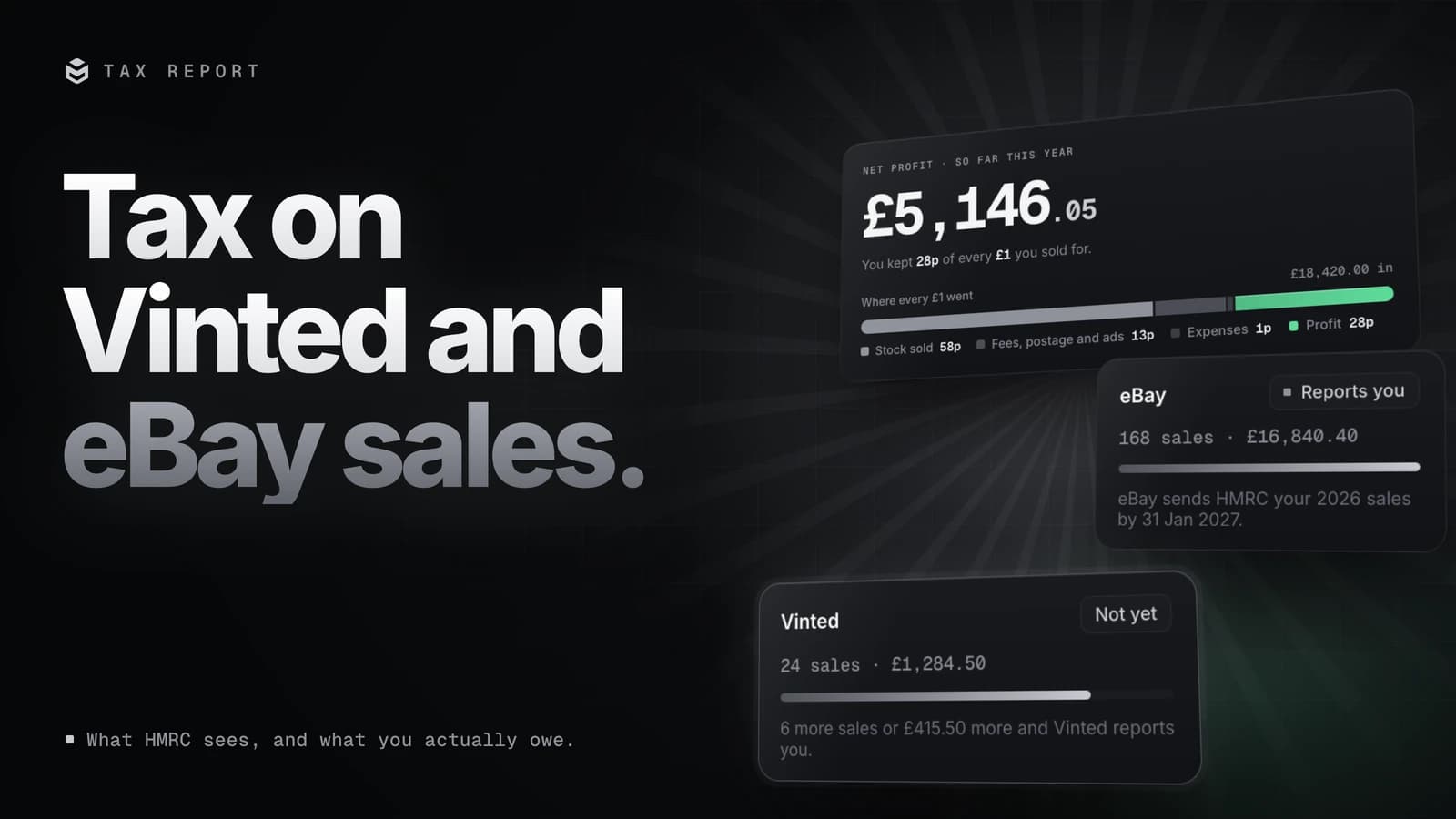
Do you pay tax on Vinted and eBay sales?What HMRC sees, and what you actually owe.
Do you pay tax on Vinted and eBay sales? Sometimes. Selling platforms now tell HMRC about their busier sellers, and that has a lot of people worried. But a report isn't a tax bill. This guide explains what gets reported, the 2 numbers that decide what you owe, and what to do before the deadlines. It's written for anyone new to selling.
On this page
- Do you pay tax on Vinted and eBay sales?
- What eBay, Vinted and Depop report to HMRC
- Being reported isn't the same as owing tax
- Selling your own things, or trading?
- The 2 numbers that decide what you owe
- Is the trading allowance going up?
- How it plays out for 3 sellers
- Selling when you're under 18
- When to register, file and pay
- The records to keep
- How the Tax Report gets your year ready
- Questions
This guide is general information about UK tax, checked against gov.uk on 28 October 2026, Budget day. It isn't financial or tax advice. Everyone's situation is different, so check gov.uk or speak to an accountant before you act on anything here.
The short version
- eBay, Vinted, Depop and other platforms tell HMRC about a seller once they make 30 sales, or take more than about £1,700, in a calendar year. You get a copy.
- Being reported isn't the same as owing tax. Selling your own unwanted things is usually tax-free. Buying things to sell for a profit is trading, and trading profit can be taxed.
- 2 numbers decide most of it. Sell more than £1,000 in a tax year and you need to tell HMRC. Income Tax only starts once your total income passes the £12,570 Personal Allowance.
- The trading allowance rises to £3,000 from 6 April 2027, announced in the Budget on 28 October 2026. It's measured on your sales, not your profit, and it's still £1,000 for this tax year.
- Register for Self Assessment by 5 October after the tax year you started. File and pay by the 31 January after that. Keep your records for at least 5 years.
Do you pay tax on Vinted and eBay sales?
It depends on what you sell and why. It doesn't depend on which app you use or how many parcels you post.
HMRC splits sellers into 2 groups. If you're selling personal possessions, things you bought to use yourself, you probably don't pay Income Tax on them. If you buy things so you can sell them for a profit, you're probably trading. Profit from trading is income, and income can be taxed.
So a wardrobe clear-out on Vinted is one thing. Buying trainers on release day, cards at a car boot or stock from a supplier to flip on eBay is another. If you're reading a reselling blog, you're probably in the second group. That's fine. It just means the rules below apply to you.
What eBay, Vinted and Depop report to HMRC
Since 1 January 2024, online marketplaces have had to collect details about their sellers and send them to HMRC once a year. These are the UK's digital platform reporting rules, and they apply to every marketplace you're likely to use.
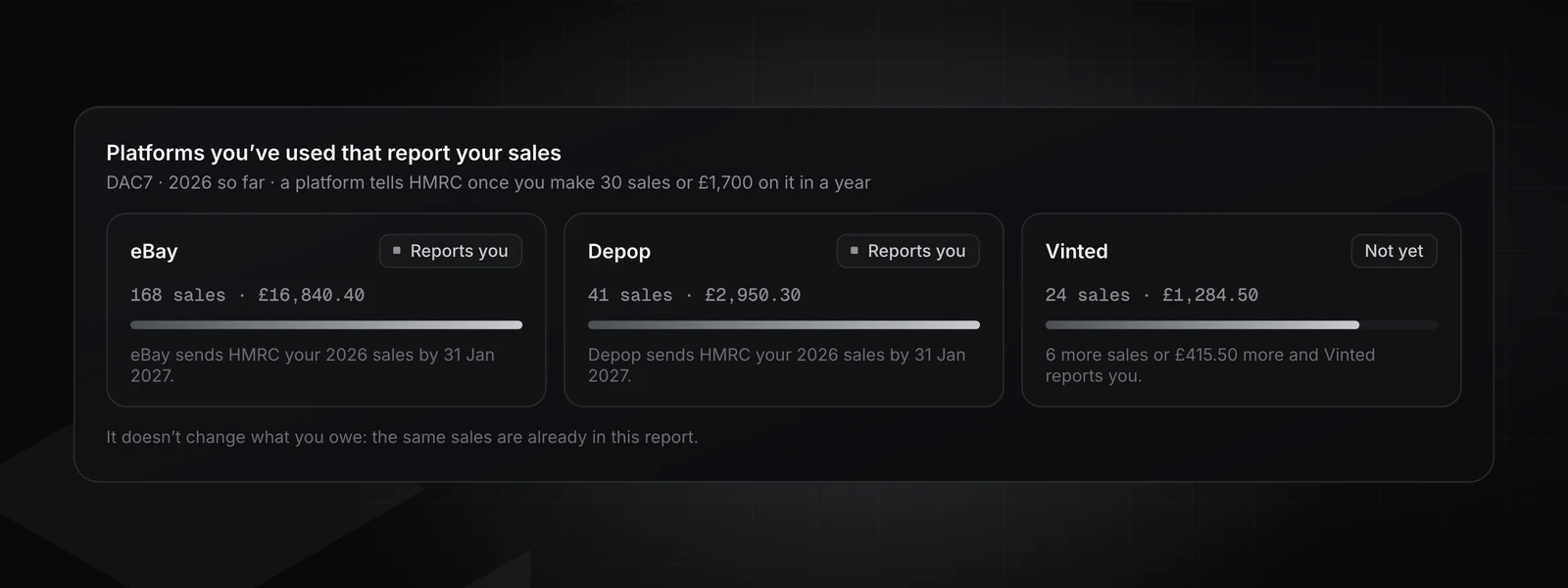
A platform reports you once you make 30 sales, or take more than 2,000 euros (about £1,700), in a year. Below both lines, it doesn't have to. eBay and Vinted both count over the calendar year, January to December, not the tax year.
For each seller it reports, the platform sends HMRC these details.
- your name, home address and date of birth
- your National Insurance number
- how much you were paid in each quarter, after the platform's deductions
- the fees and commissions it took
- how many sales you were paid for
- the bank account it paid you into, if it has it
The report for each calendar year reaches HMRC by 31 January of the next year, and you get a copy by the same date. If you sold enough on Vinted or eBay in 2026, expect yours by 31 January 2027.
The lines are per platform. 20 sales on Vinted and 20 on eBay is 40 sales, but neither platform has to report you. It doesn't change what you owe, though. Tax is worked out on everything you sell, wherever you sell it.
MINT HQ's Tax Report keeps count for you. It shows a card for each platform you sell on, with your sales so far this calendar year and how close you are to that platform's line. Before you reach it, the card says how far you have to go. Once you're over it, it says Reports you and when the platform sends HMRC your sales. So the report is never a surprise.
Being reported isn't the same as owing tax
This is where most of the worry comes from. The "30 item rule" isn't a tax rule. eBay's own announcement says it's not a new tax or a change to existing tax rules. Vinted says meeting the threshold doesn't mean you have to pay tax on your sales.
The report gives HMRC a list of sellers to check against tax returns. It works both ways.
- Reported, owe nothing. You sold 40 old things from your loft. You passed 30 sales, but selling your own possessions usually isn't taxable.
- Not reported, still owe tax. You flipped 25 pairs of trainers at a few hundred pounds profit each. You never hit 30 sales on any single platform, but you're trading. If your sales are over the trading allowance, you need to tell HMRC.
What decides it is whether you're trading and how much you make. The report doesn't.
Selling your own things, or trading?
HMRC's short version is this. You're probably trading if you sell things you bought to sell at a profit, or things you made, even as a hobby. Personal possessions are things you bought for your own use.
When it isn't clear-cut, HMRC weighs 9 "badges of trade" from its Business Income Manual. Here they are in plain words.
- Did you mean to make a profit?Buying something because you expect to sell it for more is the strongest sign.
- How many sales?One-off sales look personal. Regular, repeated sales look like trading.
- What's the item?Things people use, like a coat you wore, look personal. Things people buy to sell on, like 20 boxes of the same trainers, look like stock.
- Do you do this in other ways?Similar buying and selling elsewhere points to a trade.
- Did you change it to sell it?Cleaning, restoring, grading or upcycling to get a better price points to trading.
- How did you sell it?Selling like a shop, with listings, photos and stock to replace it, points to trading.
- How did you pay for it?Borrowing to buy something you can only repay by selling it points to trading.
- How long did you keep it?A quick turnaround points to trading. Something you owned and used for years doesn't.
- How did you get it?Buying it points one way. A gift or an inheritance points the other.
No single badge settles it. HMRC looks at the whole picture, so if yours is borderline, check gov.uk or ask an accountant.
An exception for your own things. Sell a single personal item for more than £6,000 at a profit, like a watch you've owned for years, and Capital Gains Tax can apply. Most resellers never come near it.
The 2 numbers that decide what you owe
Most of the confusion online comes from mixing up 2 different numbers. One decides whether you tell HMRC. The other decides whether you pay Income Tax.
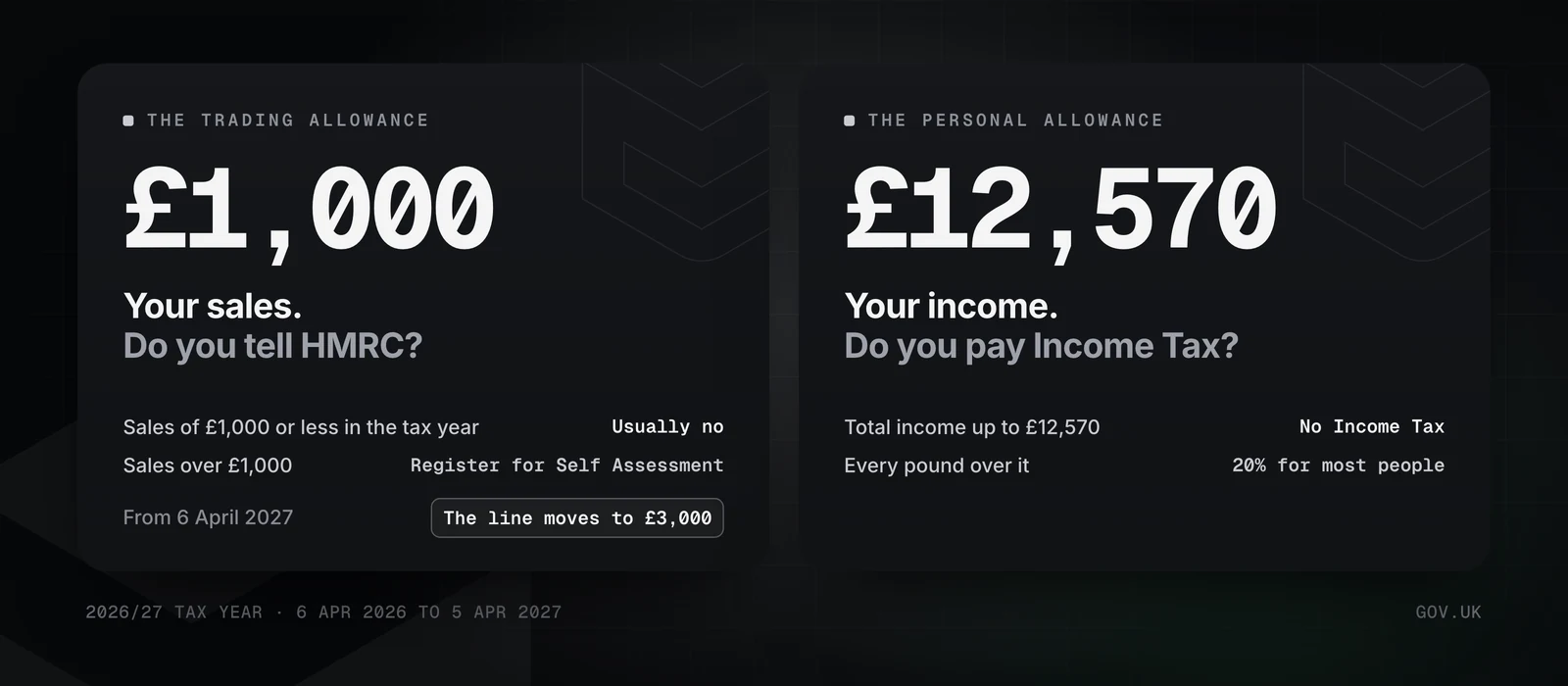
The £1,000 trading allowance decides whether you tell HMRC. It's measured on your sales, before any costs, across every platform and side hustle you have. It runs over the tax year, 6 April to 5 April.
- Sales of £1,000 or less in the tax year. You usually don't need to tell HMRC at all.
- Sales over £1,000. You need to register for Self Assessment and send a tax return, even if your costs mean you made very little.
That's for the 2026/27 tax year, the one you're selling in now. From 6 April 2027 the line moves to £3,000. More on that below.
On your return you choose how to work out your taxable profit. You take the £1,000 allowance off your sales, or you deduct your real costs. Not both. For a reseller the real costs usually win, because the biggest cost is the stock itself.
Say you sold £3,000 of trainers in a year. The pairs cost you £2,000, and fees and postage came to £300.
- Deduct your real costs. £3,000 − £2,000 − £300 = £700 taxable profit.
- Take the allowance. £3,000 − £1,000 = £2,000 taxable profit.
The allowance only wins when your costs come to less than the allowance. That's more likely if you make what you sell, or sell things you already had. From 2027/28 the same seller could take the £3,000 allowance, have nothing to tax, and not need to tell HMRC at all. Either way, you can only work it out if you know your real costs, which is why your records matter. Our free profit calculators show what you keep on each sale after fees, and How profit is worked out shows every line.
The £12,570 Personal Allowance decides whether you pay Income Tax. It's how much income you can have in a tax year before Income Tax starts. It covers all your income together, so wages from a job and your reselling profit share it. If a job already uses it up, your profit is taxed from the first pound, at 20% for most people.
On top of Income Tax, self-employed profits over £12,570 pay Class 4 National Insurance, at 6% in 2026/27. Anyone under 16 at the start of the tax year doesn't pay it.
So if reselling is your only income and your profit is under £12,570, there's no Income Tax and no National Insurance to pay. You still file a return if your sales are over the trading allowance. If your profit is under £7,105, you can choose to pay voluntary Class 2 National Insurance, £3.65 a week in 2026/27, to keep building your State Pension.
Is the trading allowance going up?
Yes, but not yet. In the Budget on 28 October 2026, the government announced that the trading allowance will rise from £1,000 to £3,000 from 6 April 2027. The line for reporting trading income through Self Assessment rises to £3,000 at the same time. The change goes into law through the Finance Bill 2026-27.
- It starts with the 2027/28 tax year. Sales from 6 April 2026 to 5 April 2027 still use the £1,000 allowance.
- It's measured on your sales, not your profit. Sell £5,000 of stock at a £1,000 profit and you're still over the line.
- Over the line, nothing else changes. You register for Self Assessment and choose between the allowance and your real costs, as now.
So if you've seen "make less than £3,000 profit a year and there's no tax to pay", that mixes up sales and profit, and it doesn't start until April 2027. Whether you pay Income Tax still depends on your total income and the Personal Allowance.
How it plays out for 3 sellers
3 made-up sellers, using the 2026/27 figures, to show how the numbers play out. From 2027/28 the trading allowance line is £3,000, but all 3 would end up in the same place.
- Sam clears out a wardrobe. 45 sales on Vinted, £900 in total, all Sam's own clothes. Vinted reports Sam, because Sam passed 30 sales. But these are personal possessions, so there's no tax to pay and nothing to tell HMRC.
- Priya has a job and flips trainers. Her salary is £28,000. She sells £9,000 of trainers that cost her £6,000, plus £500 of fees and postage, so her profit is £2,500. Her sales are over £1,000, so she registers for Self Assessment. Her salary already uses her Personal Allowance, so her profit is taxed at 20%. That's £500 of Income Tax. Her profit is under £12,570, so there's no Class 4 National Insurance.
- Jay is 14 and makes about £1,000 profit a month. That's £12,000 of profit over the tax year, from £30,000 of sales, and Jay has no other income. Jay's sales are well over £1,000, so Jay needs to register for Self Assessment and file a return. But £12,000 is under the £12,570 Personal Allowance, so there's no Income Tax. Jay was under 16 on 6 April, so there's no Class 4 National Insurance either. The return still has to go in on time. HMRC fines a late return £100, even when there's nothing to pay.
Selling when you're under 18
Your age doesn't change the tax rules. If you're trading, the same allowance, Personal Allowance and deadlines apply to you. A few things are worth knowing.
- You get the full Personal Allowance. Your profit is your income, and the first £12,570 of income in a tax year is tax-free.
- No Class 4 National Insurance while you're under 16. If you're under 16 on 6 April, you don't pay it for that whole tax year.
- You might not have a National Insurance number yet. It usually arrives in a letter shortly before your 16th birthday. If registering asks for one you don't have, call HMRC's Self Assessment helpline.
- Get a parent or guardian involved. Registering, filing and keeping records is easier with an adult helping.
- Check whose name the account is in. eBay and Vinted accounts are for over-18s. Vinted lets a parent or guardian hold an account and supervise a younger seller. When an adult holds the account, the platform's report is in their name.
When to register, file and pay
If your sales go over the trading allowance in a tax year (£1,000 for 2026/27, £3,000 from 2027/28), you register for Self Assessment by 5 October after that tax year ends. Then you file online and pay by the 31 January after that.
The 2025/26 tax year (6 April 2025 to 5 April 2026)
- register for Self Assessment by 5 October 2026
- send a paper return by 31 October 2026
- file online and pay by 31 January 2027
The 2026/27 tax year (6 April 2026 to 5 April 2027, the one you're selling in now)
- register for Self Assessment by 5 October 2027
- send a paper return by 31 October 2027
- file online and pay by 31 January 2028
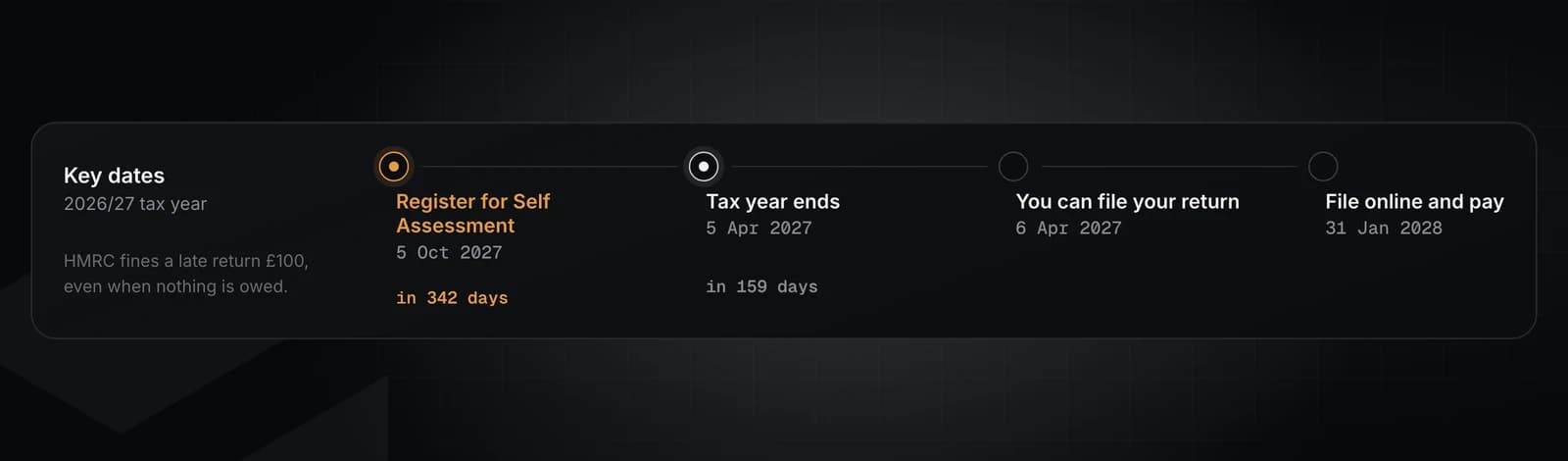
Sign up and the Tax Report counts down to your own dates, including the one to register. Start free.
If you started reselling in 2025/26 and haven't registered yet, the 5 October 2026 date has passed. Register now. HMRC can charge a penalty for telling it late, and a return filed up to 3 months late costs £100, with more after that.
One thing catches people out in their first year. If your Self Assessment bill is £1,000 or more, HMRC usually asks for payments on account. These are 2 advance payments towards next year's bill, due on 31 January and 31 July. So your first January can ask for 18 months' tax at once. Put some aside as you go.
Bigger sellers should know about Making Tax Digital for Income Tax. It already applies to sole traders whose qualifying income is over £50,000, and it reaches £30,000 from April 2027 and £20,000 from April 2028. Check gov.uk if you're near those figures. VAT is separate again: you register once your sales pass £90,000 in any 12 months, and VAT for resellers covers how MINT HQ handles it.
The records to keep
HMRC says a sole trader must keep accurate records of all sales and income and all business expenses. You keep them for at least 5 years after the 31 January deadline of the tax year they cover. Records for 2026/27, filed by 31 January 2028, are kept until at least January 2033.
For a reseller, that means keeping these.
- what you paid for each item, when, and the receipt or order confirmation
- what each item sold for, on which platform, and when
- the platform fees, postage and packaging on each sale
- refunds and returns both ways, from your buyers and to your suppliers
- your other costs, like storage, tools or software you use for the business
- what's still on your shelf at the end of the tax year
Already keep it all in a spreadsheet? You can import it into MINT HQ and keep going from there. Starting from scratch? There's a free reselling spreadsheet with the columns tax time needs.
How the Tax Report gets your year ready
This is the job we built the Tax Report for. Log your stock, sales and expenses as you go, or sync eBay so every sale logs itself with its exact fees. The tax year adds itself up, and every sale you log opens a pack.
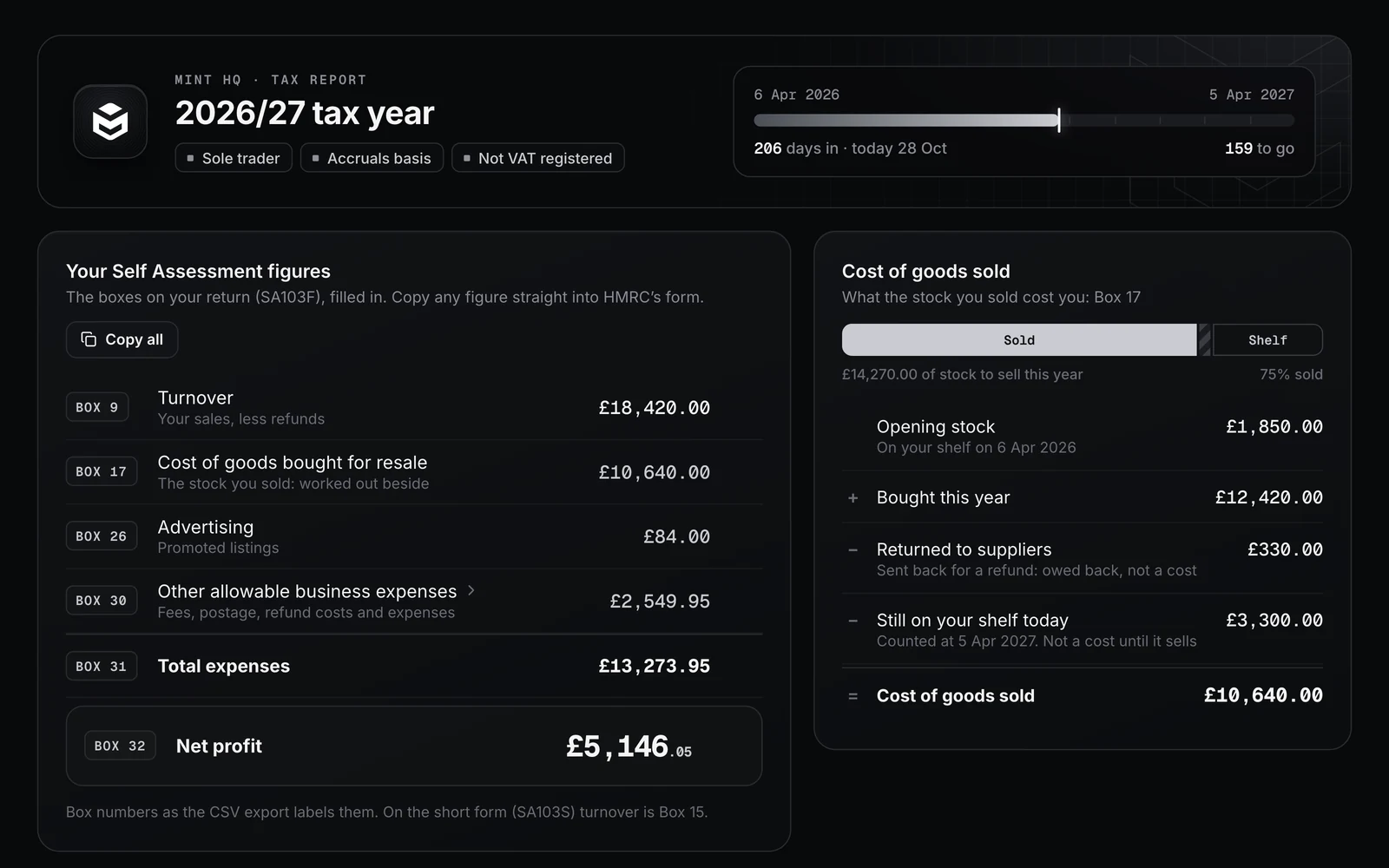
- Your Self Assessment figures, each in its box on the self-employment pages, with a copy button on every one.
- A heads-up before a platform reports you, with a card for each platform you sell on.
- Your key dates, counting down, with the registration date in red if it's overdue.
- A checklist before you file, then a PDF and a CSV for you or your accountant.
Vinted, Depop and StockX sales go in by hand or by importing a CSV. The Tax Report doesn't file your return or work out your tax bill. It gets your figures right, so filing takes an evening instead of a weekend.
Questions
Does Vinted report me to HMRC?
Only if you make 30 or more sales, or take more than 2,000 euros (about £1,700), on Vinted in a calendar year. Vinted sends HMRC the details the following January and gives you a copy. Being reported doesn't mean you owe tax.
Is there a 30 item rule for tax?
No. 30 sales is when a platform has to report you, not when tax starts. Tax depends on whether you're trading and how much you make, wherever you sell.
Is the trading allowance going up to £3,000?
Yes, from 6 April 2027. In the Budget on 28 October 2026 the government announced that the trading allowance, and the Self Assessment reporting threshold with it, will rise from £1,000 to £3,000. It's measured on your sales before costs, not your profit. For the 2026/27 tax year, the one you're selling in now, it's still £1,000.
Do I pay tax if reselling is my only income and my profit is under £12,570?
No Income Tax and no Class 4 National Insurance. Your profit sits inside the £12,570 Personal Allowance. You still register for Self Assessment and file a return if your sales are over the trading allowance. If your profit is under £7,105, you can choose to pay voluntary Class 2 National Insurance to keep building your State Pension.
I'm under 18. Do I pay tax on my sales?
The rules are the same at any age. If you're trading and your sales are over the trading allowance in a tax year (£1,000 now, £3,000 from 6 April 2027), you register for Self Assessment. You only pay Income Tax if your total income is over the £12,570 Personal Allowance, and you don't pay Class 4 National Insurance if you were under 16 on 6 April. Ask a parent or guardian to help you register.
Do I pay tax on selling my own clothes?
Usually not. HMRC says you probably don't pay Income Tax on selling personal possessions. Capital Gains Tax can apply if you sell a single item for more than £6,000 at a profit, which is rare for clothes.
Is the trading allowance per platform?
No. You get 1 trading allowance a tax year, across every platform and side hustle you have, and it's measured on what you sell before costs.
When do I need to register for Self Assessment?
By 5 October after the end of the tax year in which your sales first went over the trading allowance. For the 2025/26 year that was 5 October 2026. For 2026/27 it's 5 October 2027. Register on gov.uk.
Does MINT HQ file my tax return?
No. The Tax Report lays your year out in the Self Assessment boxes, with a PDF and CSV for you or your accountant. You file the return yourself, or your accountant does. How the Tax Report works.
Know when a new pack drops.
New sets, partner packs and limited coins, straight to your inbox. One email when something drops, nothing else.
We’ll email you once to confirm, then only when something drops. Unsubscribe any time. Privacy
The small print
This article is general information about UK tax for individuals, checked against gov.uk and HMRC guidance on 28 October 2026, including that day's Budget. It isn't financial or tax advice, and your situation may differ. Check gov.uk or speak to an accountant before you act on it. Tax rules and thresholds change. The figures here are for the 2025/26 and 2026/27 tax years. The trading allowance change from 6 April 2027 was announced in the Budget and goes into law through the Finance Bill 2026-27. The sellers in the worked examples are made up. MINT HQ's Tax Report is worked out from the records you keep in the app and is only as complete as they are. eBay, Vinted, Depop and StockX are named for illustration only, and MINT HQ isn't affiliated with them.